Advanced Diploma in International Supply Chain Operations
Advanced Diploma in International Supply Chain Operations
Course Fee: £500
About This Course
The Advanced Diploma in International Supply Chain Operations is designed to develop advanced knowledge and skills for managing and optimising global supply chains. The programme addresses leadership, supply chain operations, logistics safety and security, customs and international freight, inventory and procurement, with an emphasis on real-world application and strategic decision-making.
The course is delivered entirely online through a Virtual Learning Environment, using live webinars, discussion forums, interactive group work, case studies and real-world scenarios. It comprises six modules worth 90 credits in total, with 575 Guided Learning Hours and 800 hours of Total Qualification Time.
Eligibility
A Level 3 Diploma in Supply Chain Management or an equivalent qualification.
At least two years of relevant experience.
The programme is aimed at professionals in the supply chain and logistics industry seeking advanced skills, as well as individuals with a business management background.
Course Fees
The fee for enrolling onto this course is £500.
Module Listing
1. Leadership and Supervision in a Global Supply Chain Context (10 credits)
Develops understanding of leadership roles and responsibilities within global supply chains. Learners examine effective leadership, team performance, communication methods and strategies for team development in an international supply chain environment.
2. Principles of Supply Chain Operations Management (10 credits)
Examines key supply chain management models and the application of operational strategies. Learners also consider stakeholder roles, digital connectivity and the impact of digital transformation on supply chain operations.
3. Principles of Safety and Security in Logistics Operations (10 credits)
Explores safety and security protocols used in logistics and their effect on operations. Learners evaluate security measures and develop risk management strategies designed to protect supply chain activities.
4. Principles of Customs and International Freight (10 credits)
Develops understanding of customs regulations and their impact on international trade and freight operations. Learners also evaluate compliance strategies and the use of multi-modal transport systems within global supply chains.
5. Principles of Inventory and Procurement Management (10 credits)
Covers inventory management techniques and their contribution to supply chain efficiency. Learners evaluate procurement strategies and develop approaches for improving procurement and wider supply chain performance.
6. Capstone Project in Supply Chain Operations (40 credits)
Brings together knowledge from across the programme to address complex supply chain challenges. Learners develop and present a comprehensive supply chain strategy based on real-world scenarios and critically evaluate its effectiveness and global operational impact.
Written Assignments
The supplied course specification sets out learning outcomes and assessment criteria for each module and requires a Capstone Project that synthesises learning across the programme.
For the Capstone Project, learners are expected to develop and present a comprehensive supply chain strategy based on real-world scenarios and critically evaluate the effectiveness and impact of the proposed strategy.
The specification does not state a fixed number, word count or format of written assignments for Modules 1 to 5. These details should therefore be confirmed through the applicable assessment briefs rather than inferred.
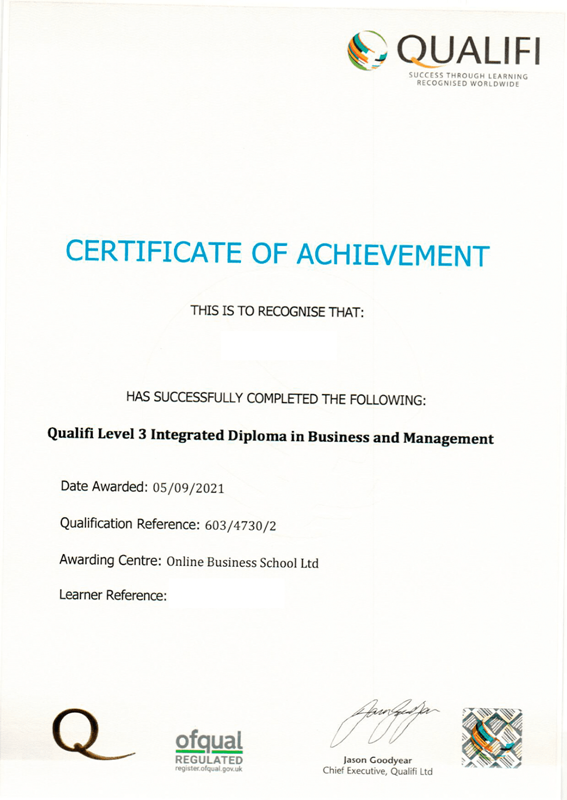
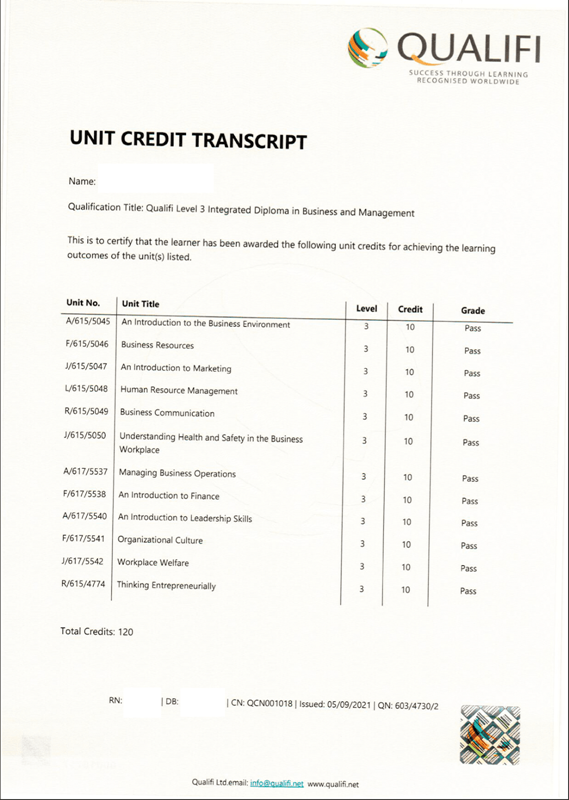
Sample Certificate
University Progression
The supplied course specification identifies the programme as preparation for advanced roles in international supply chain management, but it does not specify a university progression agreement, degree-entry route or guaranteed higher education progression pathway.
Any application for further or higher education would therefore be subject to the entry and recognition requirements of the receiving institution.