NCC Level 5 Diploma in Business (L5DB)
NCC Level 5 Diploma in Business (L5DB)
Course Fee: £4500
The Level 5 Diploma in Business (L5DB) is an advanced qualification that builds on the knowledge and skills acquired in the Level 4 Diploma in Business (L4DB). This programme introduces students to more in-depth concepts across key business disciplines, including economics, marketing, finance, and management, preparing them for higher-level academic study or professional roles in business.
About This Course
The Level 5 Diploma in Business (L5DB) is an advanced qualification that builds on the knowledge and skills acquired in the Level 4 Diploma in Business (L4DB). This programme introduces students to more in-depth concepts across key business disciplines, including economics, marketing, finance, and management, preparing them for higher-level academic study or professional roles in business.
The qualification provides a balanced blend of academic theory and vocational application, enabling learners to develop strategic thinking, problem-solving, and analytical skills essential for effective decision-making in modern business environments. Students will explore how organisations operate in dynamic markets, manage financial resources, and implement marketing strategies that drive growth.
Am I eligible for this programme?
Applicants must hold one of the following:
- The NCC Education Level 4 Diploma in Business (L4DB), or
- An equivalent qualification approved by NCC Education as comparable to the L4DB level.
All qualifications must be verified and agreed upon with NCC Education prior to admission.
Course Fees
The fee for enrolling onto this course is £4500.
Students can make payment using one of the following methods:
- Credit or Debit Card
- Bank Transfer
- Interest Free Monthly installments
- Western Union
What is included in the cost of my course?
- All course material, including online modules and written assignments.
- Personal tutor support with 1-2-1 Zoom sessions where required.
- Dedicated student support
- Access to an online social learning forum
- Assignment marking and feedback.
Module listing
Students are required to complete six of the following eight units:
Business Economics
The Business Economics module explores how organisations can achieve objectives efficiently using microeconomic theory and decision science tools such as statistics and quantitative methods. Learners examine how economic principles support strategic and operational decision-making, applying analytical techniques to real business scenarios. The module highlights the role of economic analysis in shaping effective business policies and strategies.
Advanced Business Mathematics
The Advanced Business Mathematics module focuses on applying mathematical and statistical techniques to support effective business and economic decision-making. Learners develop analytical and quantitative skills to interpret data, evaluate trends, and solve complex business problems. The module enhances the ability to make informed, evidence-based decisions in financial planning, operations, and strategic management contexts.
Marketing in Business
The Marketing in Business module emphasises the strategic importance of marketing in organisational success. It encourages managers to recognise marketing as a core business function that drives growth, competitiveness, and customer satisfaction. Learners explore how effective marketing strategies align with organisational goals, strengthening brand value and long-term business performance.
Human Resources in Business
The Human Resources in Business module examines the strategic role of HR management in achieving organisational goals. Learners explore key policies, philosophies, and practices related to recruitment, training, performance management, and employee relations. The module highlights how effective HR strategies contribute to organisational success, fostering productivity, motivation, and a positive workplace culture in modern business environments.
Understanding Consumer Behaviour
The Understanding Consumer Behaviour module explores the factors influencing how customers make purchasing decisions in consumer and industrial markets. Learners study customer needs, motivations, and decision-making processes, analysing psychological, social, and cultural influences on buying behaviour. The module equips students to apply this understanding in developing effective marketing strategies and enhancing customer satisfaction.
Principles of Business Operations
The Principles of Business Operations module examines how operations management drives organisational efficiency and effectiveness. Learners explore how products and services are delivered to meet business objectives through managing cost, quality, flexibility, dependability, and speed. The module develops an understanding of how well-designed operational systems enhance productivity, competitiveness, and overall organisational performance.
Financial Management
The Financial Management module expands on core financial and management accounting principles, applying them to real business contexts. Learners explore advanced topics such as financial planning, investment appraisal, and performance evaluation. The module develops the ability to interpret financial data, make informed decisions, and manage organisational resources effectively to achieve sustainable business growth and profitability.
Information Systems and Organisations
The Information Systems and Organisations module explores the strategic role of information systems and technology in modern organisations from a management perspective. Learners examine how digital tools support decision-making, efficiency, and innovation. The module also highlights the social, cultural, and political factors influencing successful technology adoption and organisational transformation in an increasingly digital business environment.
Assignment listing
The Level 5 Diploma in Business has 6 written assignments. The assignments are approximately 2,000-3,000 words each. Students are provided support on the modules and assignments via the ‘Tutor’ section of the learning platform.
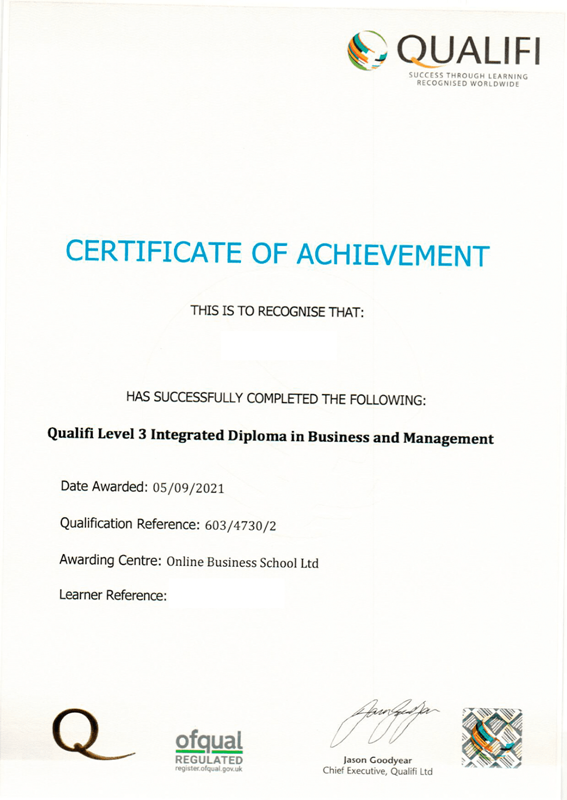
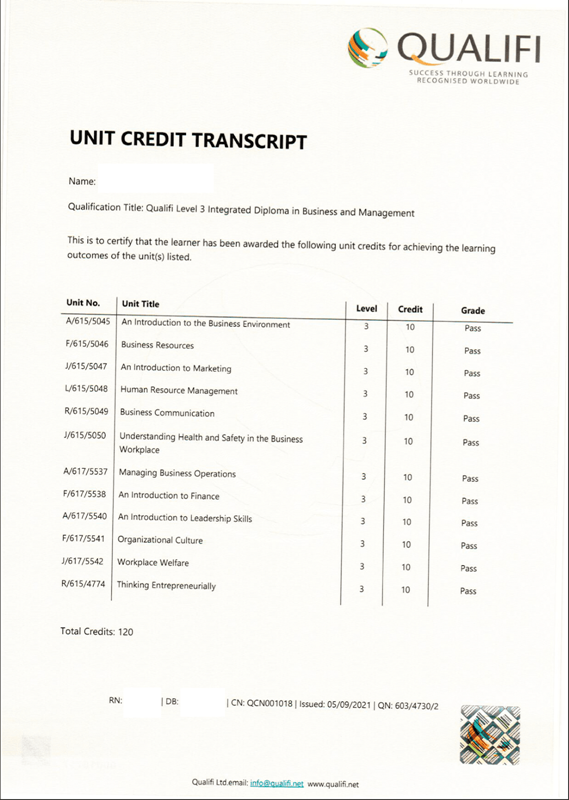
Sample Certificate
University Progression
Upon completing the Level 5 Diploma in Business, students can progress to the final year of a UK bachelor’s degree at one of many universities that recognise NCC Education qualifications. Alternatively, graduates may pursue career opportunities in business, including roles in management, marketing, finance, or entrepreneurship, applying their skills and knowledge in diverse professional settings.