ATHE Level 4 Extended Diploma in Business and Management
ATHE Level 4 Extended Diploma in Business and Management
Course Fee: £4500
The ATHE Level 4 Extended Diploma in Business and Management (120 credits) is an Ofqual-regulated qualification equivalent to the first year of a UK bachelor’s degree. It provides learners with a comprehensive foundation in business theory and practice, covering a wide range of management-related subjects.
About This Course
The ATHE Level 4 Extended Diploma in Business and Management (120 credits) is an Ofqual-regulated qualification equivalent to the first year of a UK bachelor’s degree. It provides learners with a comprehensive foundation in business theory and practice, covering a wide range of management-related subjects.
This qualification is ideal for learners seeking an in-depth understanding of how organisations operate in today’s competitive global environment. Through core and optional units, students explore topics such as marketing, finance, human resources, operations, leadership, and entrepreneurship, developing key analytical, communication, and decision-making skills.
The programme blends academic learning with practical application, preparing learners for both immediate employment and further study.
Am I eligible for this programme?
This qualification is aimed at learners aged 18 and above.
Entry requirements typically include one of the following:
- a GCE A-Level profile with two or more subjects supported by five GCSEs (grade C/4 or above),
- a related Level 3 qualification such as an ATHE Diploma,
- an Access to Higher Education Certificate, or an equivalent international qualification.
Course Fees
The fee for enrolling onto this course is £ 4500.
Students can make payment using one of the following methods:
- Credit or Debit Card
- Bank Transfer
- Interest Free Monthly installments
- Western Union
What is included in the cost of my course?
- All course material, including online modules and written assignments.
- Personal tutor support with 1-2-1 Zoom sessions where required.
- Dedicated student support
- Access to an online social learning forum
- Assignment marking and feedback.
Module listing
Learners must complete 4 mandatory units and 4 optional units.Mandatory Units
The Business Environment
This unit develops learners’ understanding of how national and global factors influence organisations. It explores external and internal environments, market dynamics, economic conditions, and regulatory frameworks, helping learners analyse how businesses adapt to changing contexts and make strategic decisions to remain competitive and sustainable in diverse operational environments.
People in Organisations
This unit focuses on how organisations manage and support people effectively. Learners study communication, teamwork, motivation, leadership, and remote working dynamics to understand how human factors impact organisational performance and culture. The unit emphasises collaboration, effective interpersonal skills, and building cohesive teams to enhance productivity and employee engagement.
Communication Skills for Business
Learners gain essential communication skills for business success. The unit covers written, verbal, and digital communication methods, exploring how effective communication enhances collaboration and decision-making. Students learn to produce professional business correspondence and presentations while understanding the importance of clarity, tone, and audience awareness in organisational contexts.
Financial and Management Accounting Techniques for Managers
This unit introduces key financial and managerial accounting principles used by business managers. Learners explore budgeting, cost control, ratio analysis, and financial planning techniques to support decision-making and performance evaluation. It builds practical skills in interpreting financial data to improve resource management and organisational effectiveness.
Optional Units
Resource Management
Learners study how organisations acquire, allocate, and utilise human and physical resources efficiently. The unit examines workforce planning, asset management, and sustainability in various sectors, including manufacturing and services. Emphasis is placed on optimising resources to achieve productivity, cost-efficiency, and long-term organisational goals.
The Marketing Mix
This unit develops learners’ understanding of the marketing mix and its seven components — product, price, place, promotion, people, process, and physical evidence. Learners explore how businesses use these elements strategically to attract customers, build brand value, and achieve competitive advantage in dynamic market environments.
Corporate Social Responsibility (CSR)
Learners explore the concept and importance of Corporate Social Responsibility. The unit examines how ethical practices, sustainability, and stakeholder engagement influence organisational reputation and performance. Students learn to evaluate CSR policies and make informed recommendations for responsible and sustainable business practices.
Managing a Work-Based Team Project
This unit equips learners with project management skills through hands-on experience. They plan, execute, and review a team project, learning about goal setting, resource allocation, collaboration, and performance evaluation. The focus is on leadership, teamwork, and reflective learning to achieve project success in workplace settings.
Entrepreneurship
Learners gain insight into entrepreneurship and its role in business growth. The unit explores entrepreneurial traits, business start-up processes, innovation, and risk management. Students learn how entrepreneurs identify opportunities, develop business ideas, and contribute to economic development through innovation and strategic planning.
Customer Relationship Management (CRM)
This unit examines the importance of effective customer relationship management in achieving business success. Learners study CRM tools, customer retention strategies, and the role of data in understanding customer needs. The focus is on building long-term customer loyalty through consistent and personalised service delivery.
Administrative Services
Learners explore the scope and importance of administrative functions in supporting business operations. The unit covers record management, office procedures, and coordination of administrative tasks. It emphasises efficiency, accuracy, and communication in providing essential support to management and operational departments.
Managing Information and Knowledge
This unit focuses on how information and knowledge are managed as strategic assets. Learners examine data collection, analysis, storage, and dissemination techniques. The emphasis is on using information systems to enhance decision-making, innovation, and competitive advantage within organisations.
Managing Operations
Learners gain a practical understanding of operations management and its role in delivering products and services efficiently. The unit explores production processes, supply chain management, quality assurance, and performance improvement. It focuses on aligning operations with organisational goals and customer expectations.
Managing Quality
This unit introduces learners to the principles of quality management. It covers quality control, assurance, and continuous improvement processes. Learners understand how maintaining high standards enhances customer satisfaction, reduces costs, and contributes to business success through effective quality management systems.
Digital Communications
Learners develop an understanding of digital communication tools and their impact on modern business. The unit explores social media, email, and digital marketing technologies, focusing on how organisations use digital platforms to enhance communication, collaboration, and engagement with stakeholders in a global digital environment.
Assignment listing
The ATHE Level 4 Extended Diploma in Business and Management has 8 written assignments. The assignments are approximately 2,000-3,000 words each. Students are provided support on the modules and assignments via the ‘Tutor’ section of the learning platform.
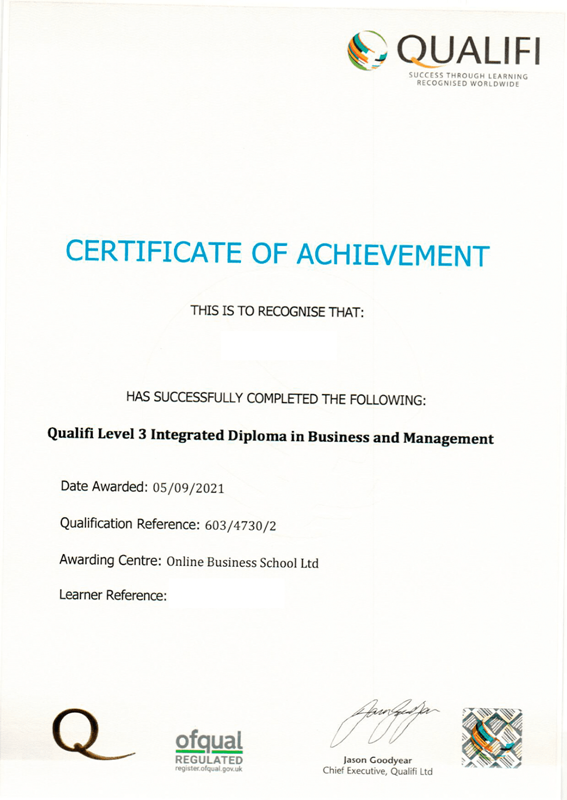
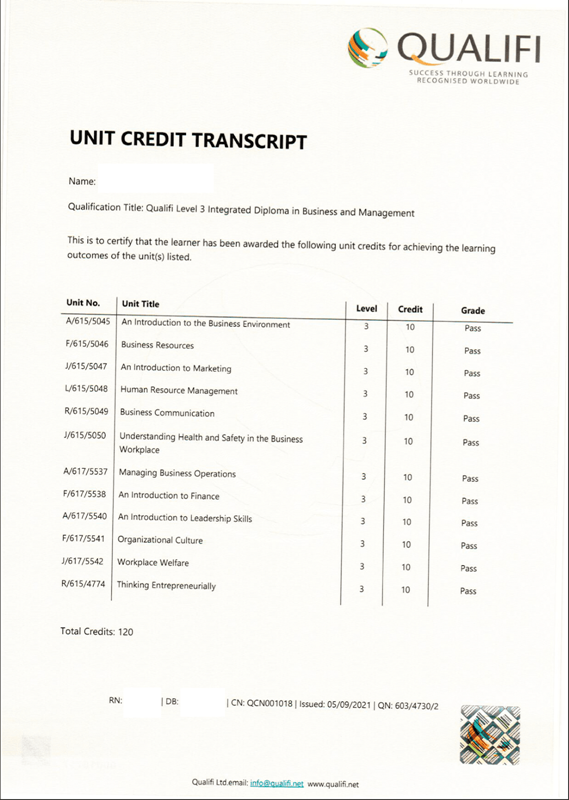
Sample Certificate
University Progression
ATHE Level 4 Extended Diploma in Business and Management enables learners to progress to the ATHE Level 5 Diploma in Business and Management or equivalent higher-level qualifications. As an Ofqual-regulated course, it also provides eligibility for direct entry into the second year of a UK bachelor’s degree in business, management, or related fields.